| . | ||
Cuba
|
||
Necropolis Cristobal Colon
|
||


 |
||
| The most interesting destination in Vedado is the Necropolis Cristobal Colon (1868). It is also considered to be one of the greatest historical cemeteries in the world. | ||
  Beside
the broad expanse of white surfaces, over past lives, reflecting the tropical
sun, there is layer after layer of fascination here. There are more than 800,000
graves and 1 million interments at the cemetery: By design, the layout of the
cemetery shows the rank and social status of the dead with distinct areas,
almost city suburbs: priests, soldiers, brotherhoods, the wealthy, the poor,
infants, victims of epidemics, pagans and the condemned. It is a city of the
dead. The best preserved and
grandest tombs stand on or near these central avenues and their axes. Beside
the broad expanse of white surfaces, over past lives, reflecting the tropical
sun, there is layer after layer of fascination here. There are more than 800,000
graves and 1 million interments at the cemetery: By design, the layout of the
cemetery shows the rank and social status of the dead with distinct areas,
almost city suburbs: priests, soldiers, brotherhoods, the wealthy, the poor,
infants, victims of epidemics, pagans and the condemned. It is a city of the
dead. The best preserved and
grandest tombs stand on or near these central avenues and their axes. |
||
|
It is also worth
noting that no aspect of the cemetery was expropriated after the 1959
revolution. This means that all of the land is in private hands. But as a
consequence of many of the wealthy fleeing the country after the revolution,
no family members are in the area to look after the resting place of their
ancestor so the elegance and grandeur of general impressions is interrupted
by empty tombs and desecrated chapels.
One aspect of the cemetery that makes it so interesting, and hardly gloomy, it is thick with symbolism, history, irony and humor. |
||


 |
||
  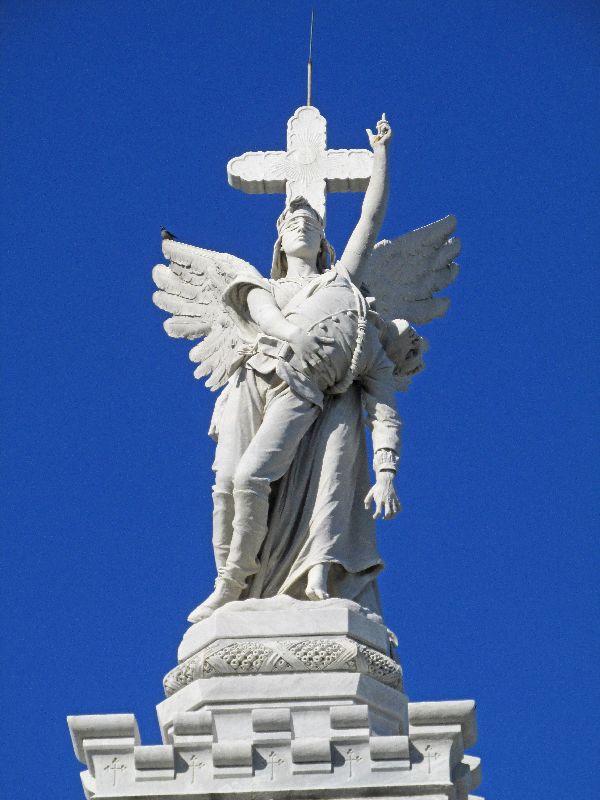 No
monument represents symbolism any better than the inspired monument for the twenty-seven
firefighters who died in the line of duty on 17 May 1890. No
monument represents symbolism any better than the inspired monument for the twenty-seven
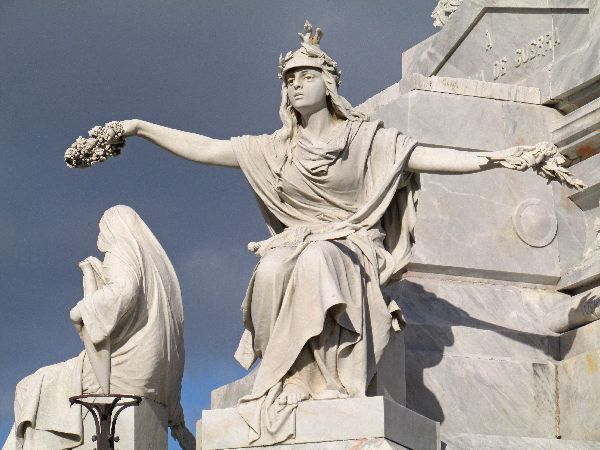
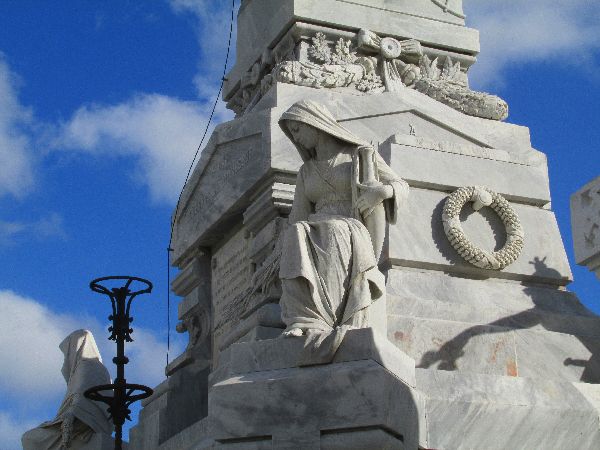
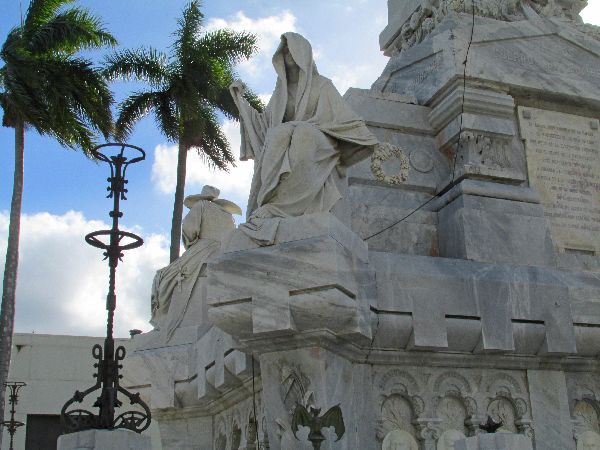
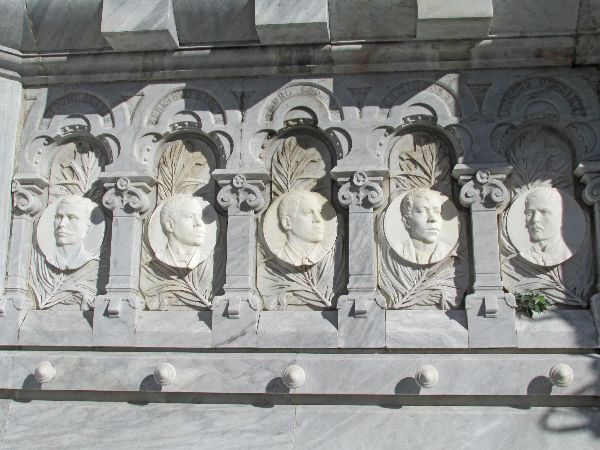
firefighters who died in the line of duty on 17 May 1890.At the top, an angle carries a firefight. On the column there are shovels, picks, gaffs, ladders, horns, bell and lanterns. At each corner is a symbolic figure: There is a nun with two pelicans at her feet. A carved portraits of each of the firefighters surround the plinth. |
||

 |
||
   The
chain hung around the monument is dripping with tear drops - one for each
fallen firefighter. The bat symbolizes betrayal. One of the reason for the
large loss of life is that the firefighters were not told of the gunpowder
that was being stored in the building. The
chain hung around the monument is dripping with tear drops - one for each
fallen firefighter. The bat symbolizes betrayal. One of the reason for the
large loss of life is that the firefighters were not told of the gunpowder
that was being stored in the building. |
||
  José Vilalta de
Saavedra also created the monument at the most visited
place in Necropolis Colon, the grave of Amelia Goyri de la Hoz [de Adot], a
woman known as "La Milagrosa" ("The Miraculous Woman" or "The Miraculous
One"). An upper-class woman, she died in childbirth in 1901 at age 23, and
her stillborn son was placed at her feet when she was buried. According to
legend, when the grave was opened years later, her corpse was intact – a
sign of holiness – and her son was nestled in her arms. Amelia is considered
by many to be Cuba's unofficial saint. Cubans come to her grave every day to
ask for children or love affairs. Villalta carved the sculpture out of one
piece of Carrara marble, and he finished the work in 1902. José Vilalta de
Saavedra also created the monument at the most visited
place in Necropolis Colon, the grave of Amelia Goyri de la Hoz [de Adot], a
woman known as "La Milagrosa" ("The Miraculous Woman" or "The Miraculous
One"). An upper-class woman, she died in childbirth in 1901 at age 23, and
her stillborn son was placed at her feet when she was buried. According to
legend, when the grave was opened years later, her corpse was intact – a
sign of holiness – and her son was nestled in her arms. Amelia is considered
by many to be Cuba's unofficial saint. Cubans come to her grave every day to
ask for children or love affairs. Villalta carved the sculpture out of one
piece of Carrara marble, and he finished the work in 1902. |
||
   The
details (right) on the memorial for the Sindicato de Empleados y Obreros
de Autobuses Modernos (Union of Employees and Workers of Modern Buses)
would indicate the members might include traditional teamsters, as well as
modern drivers. Other monuments acknowledge telephone workers, merchant
sailors, baseball players, dockworkers, and the Workers Society of La
Tropical Brewery. The
details (right) on the memorial for the Sindicato de Empleados y Obreros
de Autobuses Modernos (Union of Employees and Workers of Modern Buses)
would indicate the members might include traditional teamsters, as well as
modern drivers. Other monuments acknowledge telephone workers, merchant
sailors, baseball players, dockworkers, and the Workers Society of La
Tropical Brewery. |
||
   This triangular mausoleum belonging to the Familia Falla Bonet, which features a bronze door on which has been sculpted bearers carrying a casket into a catacomb. The door is flanked by a marble sculpture on each side - "Sorrow" on the left, "Life" on the right. At the apex of the triangle is a bronze Christ that seems to be ascending, pulling the life on Earth heavenward. The figure is the work of the noted Spanish sculptor Mariano Benlliure. |
||
   Just
behind the Familia Falla Bonet's mausoleum is another pyramid, introducing
an Egyptian element to an already eclectic architectural gumbo of the
cemetery. It is said that the owner was fascinated with Egypt and want to be
buried in a pyramid. Just
behind the Familia Falla Bonet's mausoleum is another pyramid, introducing
an Egyptian element to an already eclectic architectural gumbo of the
cemetery. It is said that the owner was fascinated with Egypt and want to be
buried in a pyramid.
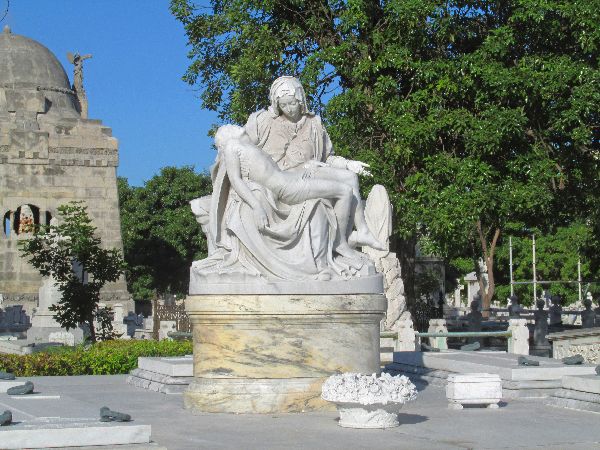
Copies of Michelangelo's "Pietra" appear a couple of times (right). The artwork depicts the body of Jesus on the lap of his mother Mary after the Crucifixion. |
||
  Both
of these monuments have touches turned down. It is a symbol that appears
frequently in the cemetery, indicating the end of life. Both
of these monuments have touches turned down. It is a symbol that appears
frequently in the cemetery, indicating the end of life.Another image that is repeated is a truncated columns with a floral wreath that seems to have slid halfway down the shaft, symbolizing a life cut short. |
||
  When
you come to the grave marked with a double three dominos tile, it is the resting
place of Luisa V. Antonia, an ardent domino player, who had a fatal heart attack
when she misplayed a double-three domino and lost a major game. When
you come to the grave marked with a double three dominos tile, it is the resting
place of Luisa V. Antonia, an ardent domino player, who had a fatal heart attack
when she misplayed a double-three domino and lost a major game.Chess Champion Jose Raul Capablanca (1888-1942) is buried, under a white marble chess king. He is considered by many as one of the greatest players of all time, widely renowned for his exceptional endgame skill and speed of play. |
||
 Eduardo
Chibas (1907-1951) was a Cuban politician who used radio to broadcast his
political views. He primarily denounced corruption and gangsterism, rampant
during the governments of Ramón Grau and Carlos Prío, which preceded the
Batista era. He believed corruption was the most important problem Cuba
faced. In August, 1952, had promised to furnish the evidence supporting his
claim that education minister Aureliano Sanchez Arango. When the evidence
was not provided to him, to make public, Chibás believed that killing
himself was the only way he could apologize for his inability to keep his
promise. Chibás shot himself during his weekly radio show; however, he had
forgotten that his allotted radio time was only 25 minutes. The shot took
place while a commercial advert for "Cafe Pilon" was running, thus
eliminating the planned effect of "his grand finale". Eduardo
Chibas (1907-1951) was a Cuban politician who used radio to broadcast his
political views. He primarily denounced corruption and gangsterism, rampant
during the governments of Ramón Grau and Carlos Prío, which preceded the
Batista era. He believed corruption was the most important problem Cuba
faced. In August, 1952, had promised to furnish the evidence supporting his
claim that education minister Aureliano Sanchez Arango. When the evidence
was not provided to him, to make public, Chibás believed that killing
himself was the only way he could apologize for his inability to keep his
promise. Chibás shot himself during his weekly radio show; however, he had
forgotten that his allotted radio time was only 25 minutes. The shot took
place while a commercial advert for "Cafe Pilon" was running, thus
eliminating the planned effect of "his grand finale".The whole country grieved his death. His funeral was attended by hundreds of thousands, including a young Fidel Castro. |
||
| There are still a many piece to
put together:
|
||
  Near
by, the crypt of Ricardo Vilalta looks as if it has been locked as tight as
a drum for decades, but over the door is a newly inland stone, carve with "PAX". Near
by, the crypt of Ricardo Vilalta looks as if it has been locked as tight as
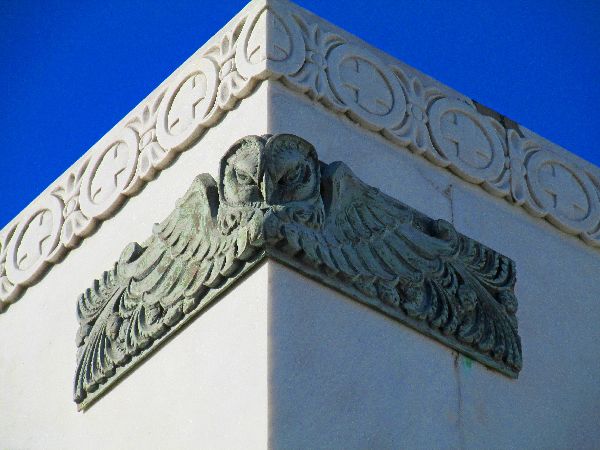
a drum for decades, but over the door is a newly inland stone, carve with "PAX".At the corner of another mausoleum an owl is watching out. |
||
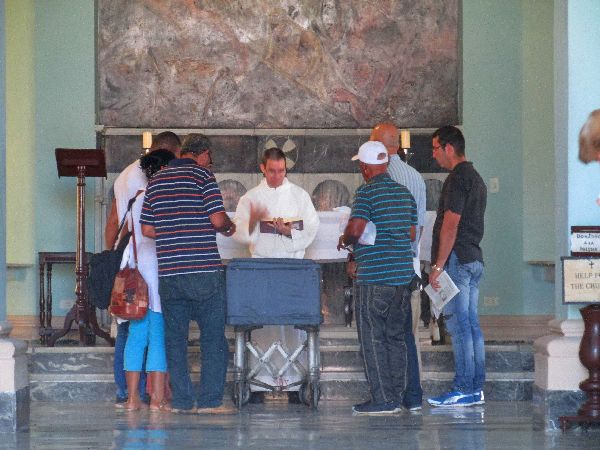   There
is a chapel at the cemetery, but so many people want to be blessed there
that they can't provide a full mass for the deceased. At busy times, about
every 10 or 15 minutes, a short cortege of vehicles (more often lead by
pick-up trucks than a hearse) drives up to the front, the casket is brought
inside, accompanied by a few family members and a brief service is held.
After this the casket is taken back out, and the process repeats itself. There
is a chapel at the cemetery, but so many people want to be blessed there
that they can't provide a full mass for the deceased. At busy times, about
every 10 or 15 minutes, a short cortege of vehicles (more often lead by
pick-up trucks than a hearse) drives up to the front, the casket is brought
inside, accompanied by a few family members and a brief service is held.
After this the casket is taken back out, and the process repeats itself. |
||


 |
||
Vedado

 Central Havana Central Havana |
||
    |
||
|
"Hosted by
DreamHost - earth friendly web hosting"
|
||
 |
|


 Please write
 IBF Homepage