| Pichincha / Imbabura | |||
| Ibike Ecuador | |||
|
Dispatch 9 - Maquipucuna | ||
 |
Left: School, field and a few of the houses in the village of Marianita, near Maquipucuna. |
 |
|
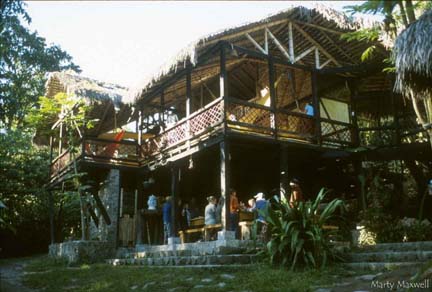 |
Left: Umachaca Lodge, Maquipucuna: The open-air design allows intimate contact with nature and the soothing sounds of the rushing Umachaca River. |
 |
|

 |
The reserve is part of the
Tumbes-Chocó-Magdalena Hotspot" (which actually extends from Panama south along
the west side of the Andes.) There are nearly 2,000 plant
species, including vivid flowering varieties such as bromeliads and orchids just
in the reserve. It incorporates habitats ranging from 4,000 to 9,000 feet above sea level, where at least three different Holdrige life zones can be found: pre-montane humid forest, low-montane humid forest and montane humid forest. Precipitation ranges between 1,500 to 3,000 mm per year, particularly from December through April. |


 |
|
 |
 Throughout
the reserve there is plenty to look at and learn about. There are a system
of Throughout
the reserve there is plenty to look at and learn about. There are a system
of
 trails
that lead out in different directions and offer different experiences. trails
that lead out in different directions and offer different experiences. |
 |
|
 |
Leaf bugs and stick bug, which look like leaves and twigs, respectfully, are one of the fascinating creatures at Maquipucuna. |
 |
|
 |
Hummingbird, though hard to photograph, are another crowd pleaser. There have been 370 bird species, including 20 hummingbirds; and, 250 species of butterflies, found on the reserve. | ||
| Strangler figs encase other tree. After sprouting in the tops of the trees from seeds dropped by birds and bats, it acts like a vine, sending roots to the ground that join together and thicken, enveloping the trunk of the host tree. The fig tree’s roots put pressure on its victim tree and cut off the circulation of nutrients while the fig tree’s branches quickly grow above the host tree to block it from the sunlight it needs to live. The host tree dies and its body rots within, leaving a hollow core that is later filled by the fig tree as well as small animals and insects. |
 |
||

 |
There are many types of epiphytes at Maquipucuna; ferns, mosses, and bromeliads (which includes 250 orchid varieties) are some examples. Epiphytes live on trees to take advantage of the sunlight that is more available on tree branches and trunks than on the forest floor. Trees are beneficial to epiphytes, providing them with a place to live but gaining nothing in return. Epiphytes are not parasites, doing no direct damage to their tree hosts, but they do force the trees to put more energy into their support systems. Also, epiphytes can shade leaves of the host tree, stealing some of it's sunlight. To minimize being used by epiphytes many trees have features like peeling bark, bark that is chemically intolerable, or the habit of dropping their lower branches. |


 |
|
 |
Heliconia is closely related the banana. Also, be on the look out for Hermit hummingbirds buzzing by, stopping momentarily to feed on the nectar of the Heleconia flowers. Hermits and Heleconia have an equally rewarding relationship; Heleconia provides nectar for the Hermits who, in return, pollinate Heleconia flowers so they can bear fruit. |
 |
|
| Maquipucuna has some interested vertebrates and invertebrates, including the Andes Spotted Bear and 44 other mammals, but one of the more interesting critters is the leaf-cutter ant. You might assume that these ants eat leaves. Not so. The ants carry leaf pieces to their nests where they chew them up into fine bits and form them into a compost heap. A special type of fungus grows on this heap, a fungus that produces fruiting bodies which are the food of the ants. These fungi have not been found outside of the ant nests. When the ants move, the queen takes a bit of the fungus with her so she can easily start growing it in the new nest. Leaf-cuter ants and fungi are entirely dependent on each other; the ants distribute and provide a substrate for the fungus to grow on while the fungi provide food for the ants. |

 |
||
| And here is a totally unrelated, but rather elegant, fungus. |
 |
||
 |
Look for the Cercropia trees in the lower left center of the photo. These trees are easy to identify by their large, palmate leaves. These trees are pioneer species, which means they are one of the first tree species to occupy a place where there has been a disturbance such as a tree fall, timber harvest or landslide. They put most of their energy into growing rapidly and because of this they do not have enough energy to produce a good system of defense against their predators. Cercropias solve this problem by recruiting the assistance of Azteca ants. In a mutually beneficial relationship, Cercropias provide ants whit homes in their hollow trunks, and food which is full of protein and carbohydrates. In exchange, the ants protect the tree from herbivorous insects and animals by attacking them with their strong jaws as well as predator-deterring chemicals. | ||

 |
Along the rivers around Maquipucuna,
fish farming is becoming increasingly. The projects range from small (left), to mid-size
(top) and large (bottom). Exotic talapia and trout are the
most common species.
 The are some ecological concerns by environmentalists
because fish are escaping into the river systems and competing successfully with
indigenous species. The are some ecological concerns by environmentalists
because fish are escaping into the river systems and competing successfully with
indigenous species. |

 |
|
|
|
|||
 |
|||
|
"Hosted by
DreamHost - earth friendly web hosting"
|
|||




 Please
contact us
Please
contact us IBF Homepage