

Bicycle Statistics: Usage, Production, Sales, Import, Export

 IBF is 100%
solar powered

Hard facts on bike usage, production, sales, imports, exports and trade are hard to come by. Many of the best statistics are buried in papers that are presented at conferences such as VeloCity, ProBike and the Transportation Research Board (TRB). Sometimes these papers are published after the conferences but it can then be difficult to get a hold of the proceeding, and then they aren't very well indexed so you have to go through all of all of them to extract anything that might be useful to you.
We do not have the staff to be able to research this thoroughly. If you are able to find a good source of information please let us know so that we can share it with others.
Tracking Global Bicycle Ownership Patterns, Journal of Transport & Health, Dec 2015. Related article.
Report on the economic potential of bicycles in developing countries.
Bicycling in Copenhagen infographic with history and statistics.
Bike Commuting In a Motorized World infographic (mostly USA data).
Separated Bike Lanes = Safer Streets for Everyone infographic (mostly USA data).
World Bicycle Production, 1950-2018 (graph)
Bicycle production fell to 79 million units in 1998, 25 percent below the peak of 107 million bicycles in 1995. Source: State of the World 2001, World Watch Institute, Washington DC USA
Percent of Trips by Travel Mode (all trip purposes) |
|||||
| Country | bicycle | walking | public transit | car | other |
| Netherlands | 30 | 18 | 5 | 45 | 2 |
| Denmark | 20 | 21 | 14 | 42 | 3 |
| Germany | 12 | 22 | 16 | 49 | 1 |
| Switzerland | 10 | 29 | 20 | 38 | 1 |
| Sweden | 10 | 39 | 11 | 36 | 4 |
| Austria | 9 | 31 | 13 | 39 | 8 |
| England/Wales | 8 | 12 | 14 | 62 | 4 |
| France | 5 | 30 | 12 | 47 | 6 |
| Italy | 5 | 28 | 16 | 42 | 9 |
| Canada | 1 | 10 | 14 | 74 | 1 |
| United States | 1 | 9 | 3 | 84 | 3 |
| Source: John Pucher, Transportation Quarterly, 1997, Volume 51, Number 4, page 32 (from various transport ministries and depts., latest avail. year) | |||||
Bicycle mileage per person and killed cyclists per mileage in ten countries; Source: WALCYNG, Report1. no.4, 1997, Lund University Sweden and Factum Austria. Bicyclists' safety increases with increased bicycling in developed countries..
|
Bicycle Kilometres and Killed Cyclists per kilometre |
Cycling kilometres per person per day |
Killed cyclists per 100 million kilometres |
|
GREAT BRITAIN |
0.1 |
6.0 |
|
ITALY |
0.2 |
11.0 |
|
AUSTRIA |
0.4 |
6.8 |
|
NORWAY |
0.4 |
3.0 |
|
SWITZERLAND |
0.5 |
3.7 |
|
FINLAND |
0.7 |
5.0 |
|
GERMANY |
0.8 |
3.6 |
|
SWEDEN |
0.9 |
1.8 |
|
DENMARK |
1.7 |
2.3 |
|
THE NETHERLANDS |
3.0 |
1.6 |
By Wittink, Roelof; I-ce Interface for Cycling Expertise: Planning for cycling supports road safety; In: Sustainable Transport, Planning for walking and cycling in urban environments, ed. Rodney Tolley; Woodhead publishing in Environmental management, ISBN 1 85573 614 4; 2003
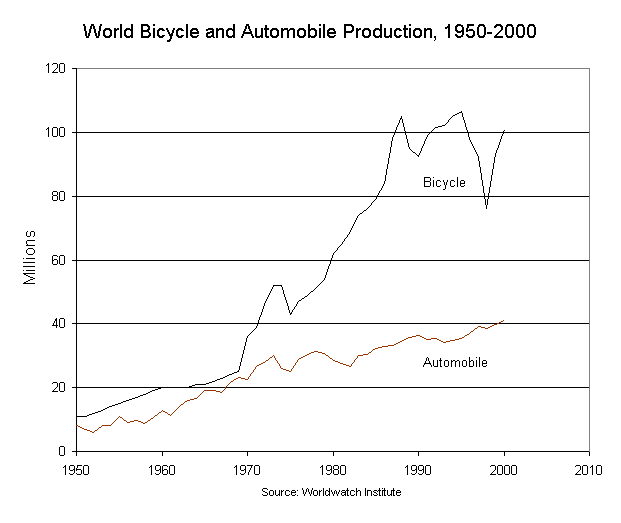
World Bicycle and Automobile Production, 1950-2000
|
World Bicycle
and Automobile Production, 1950-2000
|
|||
| Year |
Bicycle Production
|
Auto Production |
Auto Fleet |
|
Million Units
|
|||
| 1950 |
11
|
8
|
53 |
| 1951 |
11
|
7
|
|
| 1952 |
12
|
6
|
|
| 1953 |
13
|
8
|
|
| 1954 |
14
|
8
|
|
| 1955 |
15
|
11 |
73 |
| 1956 | 16 |
9
|
|
| 1957 |
17
|
10
|
|
| 1958 |
18
|
9
|
|
| 1958 |
19
|
11
|
|
| 1960 |
20
|
13
|
98 |
| 1961 |
20
|
11
|
|
| 1962 |
20
|
14
|
|
| 1963 |
20
|
16
|
|
| 1964 |
21
|
17
|
|
| 1965 |
21
|
19
|
140 |
| 1966 |
22
|
19
|
148 |
| 1967 |
23
|
19 |
158 |
| 1968 |
24
|
22
|
170 |
| 1969 |
25
|
23
|
181 |
| 1970 |
36
|
23
|
194 |
| 1971 |
39
|
27
|
207 |
| 1972 |
46
|
28 |
220 |
| 1973 |
52
|
30
|
236 |
| 1974 |
52
|
26
|
249 |
| 1975 |
43
|
25
|
260 |
| 1976 |
47
|
29
|
269 |
| 1977 |
49
|
31
|
285 |
| 1978 |
51
|
31
|
297 |
| 1979 |
54 |
31
|
308 |
| 1980 |
62
|
29
|
320 |
| 1981 |
65
|
28
|
331 |
| 1982 |
69
|
27
|
340 |
| 1983 |
74
|
30
|
352 |
| 1984 |
76
|
31
|
365 |
| 1985 |
79
|
32
|
374 |
| 1986 |
84
|
33
|
386 |
| 1987 |
98
|
33
|
|
| 1988 |
105
|
34
|
|
| 1989 |
95
|
36
|
|
| 1990 |
92
|
36
|
|
| 1991 |
99
|
35
|
|
| 1992 |
102
|
36
|
|
| 1993 |
102
|
34
|
|
| 1994 |
105
|
35
|
|
| 1995 |
106
|
35
|
|
| 1996 |
98
|
37
|
|
| 1997 |
92
|
39
|
|
| 1998 |
76
|
38
|
|
| 1999 |
96
|
40
|
|
| 2000 |
104
|
41
|
|
| 2001 |
97 |
||
| 2002 |
104 |
||
| Source: Historical data series compiled by Worldwatch Institute, Vital Signs 1996, 2002, 2005 (New York: W.W. Norton & Company, 1996, 2002). | |||
As can be seen from the figures, global automobile production very nearly
caught up to bicycles in terms of total numbers by the late 1960's, but since
then bicycle production has far outstripped that of automobiles and now stands
at better than a 3:1 ratio; so while bike sales may be steady or declining in
America over the past few years, they continue to make enormous gains in other
parts of the world--particularly Asia where China alone is now producing more
bikes (40+ million per year) than all the world's automotive output.
Note also that while the global automobile fleet has expanded from less than 150
million to nearly 500 million over the past 30 years, during that same time over
2 billion bikes were manufactured, and the number of
utilitarian/transportation cyclists around the world has grown to over 1 billion
(of which China now represents about half the total).
| Bicycle and other cycle, not motorized production, by Country (latest year available) | ||||
| Country | Year | Unit | Value | Footnotes |
| Algeria | 2004 | Thousand Units | 2.7 | |
| Armenia | 2008 | Thousand Units | 0.4 | |
| Azerbaijan | 2007 | Thousand Units | 200 | |
| Bangladesh | 2006 | Thousand Units | 27.638 | 1 |
| Belarus | 2008 | Thousand Units | 250.282 | |
| Belgium | 2003 | Thousand Units | 173.3 | 3 |
| Brazil | 2008 | Thousand Units | 2850.427 | |
| Bulgaria | 2008 | Thousand Units | 474.453 | |
| Cameroon | 1995 | Thousand Units | 0.801 | |
| Canada | 1997 | Thousand Units | 912.59 | |
| Central African Rep. | 1995 | Thousand Units | 0.65 | |
| Chad | 1995 | Thousand Units | 2 | |
| Chile | 2008 | Thousand Units | 79.228 | |
| China | 2008 | Thousand Units | 63748.7 | |
| Colombia | 1999 | Thousand Units | 54.109 | 4 |
| Croatia | 2003 | Thousand Units | 0 | |
| Cuba | 2008 | Thousand Units | 53.3 | |
| Czech Republic | 2008 | Thousand Units | 304.634 | |
| Denmark | 2008 | Thousand Units | 120.445 | |
| Egypt | 2000 | Thousand Units | 3 | |
| El Salvador | 1997 | Thousand Units | 2.421 | |
| Finland | 2008 | Thousand Units | 23.005 | |
| France | 2003 | Thousand Units | 12372 | |
| Georgia | 1996 | Thousand Units | 0.951 | |
| Germany | 2008 | Thousand Units | 1866 | |
| Greece | 2004 | Thousand Units | 159.711 | 6 |
| Hungary | 2008 | Thousand Units | 356 | |
| India | 2007 | Thousand Units | 11397 | |
| Indonesia | 2002 | Thousand Units | 2064 | |
| Iran(Islamic Rep. of) | 2000 | Thousand Units | 185 | 7 |
| Iraq | 2008 | Thousand Units | 0.576 | |
| Ireland | 2004 | Thousand Units | 0 | |
| Italy | 2004 | Thousand Units | 3982.579 | |
| Japan | 2008 | Thousand Units | 2200.807 | |
| Kazakhstan | 2007 | Thousand Units | 0 | |
| Korea, Republic of | 2005 | Thousand Units | 2.249 | |
| Kyrgyzstan | 2008 | Thousand Units | 0 | |
| Latvia | 1999 | Thousand Units | 2.098 | |
| Lithuania | 2008 | Thousand Units | 392.73 | |
| Mexico | 2008 | Thousand Units | 1601.6 | |
| Mozambique | 1997 | Thousand Units | 0 | |
| Myanmar | 2007 | Thousand Units | 53.878 | |
| Netherlands | 2007 | Thousand Units | 971 | 9 |
| Pakistan | 2008 | Thousand Units | 535.519 | 1 |
| Peru | 2005 | Thousand Units | 23.29 | |
| Poland | 2008 | Thousand Units | 1432.4 | |
| Portugal | 2006 | Thousand Units | 705 | |
| Romania | 2007 | Thousand Units | 277 | |
| Russian Federation | 2008 | Thousand Units | 1434 | |
| Serbia and Montenegro | 2003 | Thousand Units | 2.544 | |
| Slovakia | 2008 | Thousand Units | 56.958 | |
| Spain | 2001 | Thousand Units | 491 | |
| Sweden | 2008 | Thousand Units | 154.7724 | |
| Turkmenistan | 1997 | Thousand Units | 0 | |
| Ukraine | 2008 | Thousand Units | 381.292 | |
| United Kingdom | 2007 | Thousand Units | 0 | |
| Viet Nam | 2008 | Thousand Units | 1689 | |
| Footnote | ||||
| 1 | Twelve months ending 30 June of year stated. | |||
| 2 | Provisional or estimated figure. | |||
| 3 | Incomplete coverage. | |||
| 4 | Including tricycles. | |||
| 5 | Including delivery tricycles. | |||
| 6 | Excluding Prodcom code 35.42.10.30. | |||
| 7 | Factory employing 10 or more persons. | |||
| 8 | Government production only. | |||
| 9 | Sales. | |||
| Source: Industrial Commodity Statistics Database | United Nations Statistics Division | ||||
It is difficult to compare these numbers because many countries don't report every year and some countries don't report at all. They also don't reflect trends in specific countries, which may be towards increased production or decreased production. Trend information is available by filtering for a specific country at http://data.un.org/Data.aspx?d=ICS&f=cmID:49921-0
| Bicycle Production of Selected Countries, 1990-2000 | |||||||||||
| 1990 | 1991 | 1992 | 1993 | 1994 | 1995 | 1996 | 1997 | 1998 | 1999 | 2000 | |
|
Million Units
|
|||||||||||
| China |
31.9
|
36.8
|
40.3
|
41.0
|
42.0
|
41.0
|
38.0
|
30.0
|
23.1
|
42.7
|
52.2
|
| France |
1.5
|
1.2
|
1.0
|
1.0
|
1.3
|
1.3
|
1.3
|
1.3
|
1.6
|
1.8
|
1.9
|
| Germany |
3.9
|
4.9
|
4.6
|
4.1
|
3.5
|
3.2
|
2.9
|
2.8
|
3.2
|
3.2
|
3.2
|
| India |
8.4
|
8.8
|
9.0
|
9.9
|
10.5
|
11.5
|
11.3
|
11.0
|
10.5
|
11.0
|
11.0
|
| Indonesia |
2.0
|
2.0
|
2.2
|
2.5
|
2.8
|
3.0
|
2.3
|
3.0
|
2.8
|
2.6
|
N/A
|
| Italy |
3.5
|
3.6
|
4.1
|
5.2
|
5.8
|
5.3
|
4.0
|
4.0
|
3.0
|
3.3
|
3.2
|
| Japan |
8.0
|
7.5
|
7.3
|
6.9
|
6.7
|
6.6
|
6.1
|
6.0
|
5.9
|
5.6
|
4.7
|
| Korea |
1.5
|
1.5
|
1.3
|
1.1
|
1.2
|
N/A
|
0.9
|
0.8
|
0.6
|
0.6
|
N/A
|
| Malaysia |
0.3
|
0.4
|
0.6
|
0.7
|
0.8
|
0.8
|
0.5
|
0.8
|
0.7
|
0.8
|
N/A
|
| Taiwan |
6.8
|
7.7
|
7.5
|
7.9
|
9.2
|
9.7
|
7.4
|
11.9
|
10.1
|
8.3
|
7.5
|
| Thailand |
0.7
|
0.8
|
1.0
|
1.0
|
1.1
|
1.8
|
1.5
|
1.8
|
1.6
|
1.5
|
N/A
|
| United Kingdom |
1.3
|
1.2
|
1.2
|
1.1
|
1.2
|
1.2
|
1.2
|
1.3
|
1.2
|
1.3
|
1.2
|
| United States |
5.6
|
7.6
|
8.9
|
7.7
|
7.3
|
8.8
|
8.0
|
6.0
|
2.5
|
1.7
|
1.1
|
| N/A indicates not available. | |||||||||||
| Source: Bicycle Retailer & Industry News Directory, from Cycle Press, European Bicycle Manufacturers Association, Japan Bicycle Promotion Institute, Bike Europe, and Bicycle Retailer & Industry News. | |||||||||||
| United States Bicycle Market, 1991-2000 | |||
| Year | Total Shipments | Imports | Domestic Production |
|
Million Units
|
|||
| 1991 |
15.1
|
6.5
|
8.6
|
| 1992 |
15.4
|
6.3
|
9.1
|
| 1993 |
16.8
|
7.1
|
9.7
|
| 1994 |
16.7
|
7.0
|
9.7
|
| 1995 |
16.2
|
7.2
|
9.0
|
| 1996 |
15.5
|
7.5
|
8.0
|
| 1997 |
15.2
|
9.8
|
5.4
|
| 1998 |
15.8
|
13.8
|
2.0
|
| 1999 |
17.5
|
16.3
|
1.2
|
| 2000 |
20.9
|
20.2
|
0.7
|
| Source: Bicycle Retailer & Industry News Directory, from The Bicycle Council, U.S. Department of Commerce, and Bicycle Retailer & Industry News. | |||
| Selected Bicycle Promotion Initiatives Around the World | ||
| Compiled by Janet Larsen, Earth Policy Institute, July 2002. | ||
| City | Country | Initiative |
| Australia | Plans to double bicycle use by 2004 by developing a network of trails, end-of-trip facilities, improving bicycle safety. | |
| Santiago | Chile | 30-40 kilometer bike path pilot project currently funded by the Global Environment Facility could grow to 1,000 kilometers over 10 years. |
| Bogotá | Columbia | Some 300 kilometers of bicycle paths have been completed; all cars are banned from 120 kilometers of the city's main streets on Sundays and holidays; referendum was passed to prohibit car circulation during rush hours by 2015. |
| France | The French Environment Ministry, together with the Transportation Ministry, created a national bicycle plan in 1994, granting near $2 million for 10 bicycle promotion projects based on the Dutch model. | |
| Germany | Over 31,000 kilometers of paths and lanes exclusively for bicycles. | |
| Tokyo | Japan | Cost of owning a car is high: fuel taxes double those of the United States account for almost half of the price of gas; automobile tax levies and vehicle inspection fees amount to an average of almost $2,000 annually. |
| Nagoya | Japan | Employer contributions for commuting by bicycle doubled in 2000, while allowances for automobile commuters were halved. |
| Netherlands | First country to establish an official national bicycle policy; currently almost 19,000 kilometers of paths and lanes exclusively for bicycles. | |
| Lima | Peru | Low-interest loans available to low-income families for the purchase of the bicycle are helping the city to meet its goal to increase percent of trips by bicycle from 2 percent in the mid 1990s to 10 percent. Over 60 kilometers of bike paths have been built along major traffic corridors. |
| United States | Almost $3 billion in federal funding allocated for bicycle and pedestrian projects between 1998 and 2003 under the Transportation Equity Act for the 21st Century. | |
UKDOT Journey Times Survey 1996
(ISBN 0 11 551926 2), published by the Stationery Office and featured in DOT Press Release 106 of 28.5.96. The findings include:-
- For journeys entirely within Central London, the average time was 33 minutes by car compared with 18 minutes by bike. By public transport the journeys took, on average, 31 minutes by rail and 38 minutes by bus. Taxi journeys took 20 minutes on average.
- The average direct distance (as the crow flies) for the short radial journeys was 3.9 miles, and for the central journeys 1.7 miles. However, the actual distances traveled were much longer. For example, the average on-road distance for short radial journeys by bike was 5.2 miles, and by car was 5.6 miles for central journeys these distances were 2.3 miles for bikes and 2.7 miles for cars.
- The proportion of time spent "in-vehicle" varied considerably by mode; from 97% for short radial bike journeys to only 30% from central rail journeys
The report includes comparisons with the same journeys surveyed in 1993. For all modes, except the bike, the 1996 journeys were slower on average than the 1993 journeys. The changes reported are subject to a number of influences (such as choice of routes and parking places, and worse weather in 1996), in addition to changes in congestion.
- For short radial journeys, the fastest made in 1996 was bicycle, and the slowest was bus, as in 1993, but bicycle was slightly faster in 1996.
- In contrast to other modes, there were overall reductions in time for both short radial and central bike journeys, by 8% and 5% respectively.
This is interesting firm evidence of the increasing advantages of bikes over other modes as congestion continues to worsen. (Hugh McClintock, 1996)
Mode Space Requirements
One single-occupant car requires 75 times the amount of urban space as a pedestrian, 20 times that of a cyclist, and 13-40 times that of rail transit per unit of personal movement achieved (Professor John Whitelegg, 1993)
True Costs of Road Transport
In 1993 Professor David Pearce and colleagues analyzed the external societal costs of UK road transport and came up with an annual figure of £22.25 billion (US$ 35.6 billion).
In "Blueprint Five: The True Costs of Road Transport" they have revisited their findings and made substantial upward adjustments. There are much higher levels for noise (£3 billion annually) and congestion (£19 billion). New information about the danger of particulate – especially PM10’s from diesel – has led to a substantial upward revision in the cost of air pollution. Taken in total, Pearce and company now believe, the annual cost to society imposed by road transport to be £46-53 billion.
"Blueprint Five" is published by Earthscan at £10.95. [CTC Cycle Digest] (1998)
1996 US State Traffic Satety Stats
Compiled by Riley Geary, from data of the National Center for Statistics and Analysis, a part of
the NHTSA. They now have a state-by state summary of traffic safety
statistics
at:
https://cdan.dot.gov/STSI/stsi.htm
[Note the meaning of these numbers generated a lively discussion on several list servers!]
$B |
Deaths |
$/D |
/VMT |
/Pop |
%P |
%B |
%>.10 |
%Spd |
SB:D% |
SB:U% |
10yr |
3yr |
|
AL |
2 |
1143 |
1.7 |
22 |
26.8 |
8 |
0.5 |
34 |
37 |
29 |
54 |
+ |
+ |
AK |
0.3 |
80 |
4 |
19 |
13.2 |
10 |
5 |
43 |
38 |
31 |
69 |
- |
-- |
AZ |
2.5 |
993 |
2.5 |
24 |
22.4 |
16 |
2.9 |
35 |
29 |
39 |
63 |
. |
++ |
AR |
1.4 |
615 |
2.3 |
22 |
24.5 |
4 |
0.8 |
26 |
37 |
29 |
48 |
. |
+ |
CA |
15.6 |
3989 |
3.9 |
14 |
12.5 |
20 |
3.1 |
31 |
35 |
60 |
88 |
-- |
- |
CO |
1.8 |
617 |
2.9 |
17 |
16.1 |
12 |
1.5 |
34 |
42 |
37 |
59 |
. |
+ |
CT |
2.1 |
310 |
6.8 |
11 |
9.5 |
16 |
1.3 |
39 |
28 |
27 |
62 |
-- |
- |
DE |
0.4 |
116 |
3.3 |
15 |
16 |
17 |
2.6 |
29 |
22 |
55 |
68 |
- |
. |
DC |
0.5 |
62 |
8.1 |
19 |
11.4 |
33 |
1.6 |
35 |
47 |
32 |
58 |
+ |
+ |
FL |
8.9 |
2753 |
3.2 |
21 |
19.1 |
20 |
3.9 |
29 |
25 |
41 |
64 |
. |
+ |
GA |
4.3 |
1574 |
2.7 |
18 |
21.4 |
10 |
1 |
28 |
23 |
35 |
62 |
. |
+ |
HI |
0.6 |
148 |
4.3 |
18 |
12.5 |
20 |
3.4 |
29 |
36 |
53 |
80 |
+ |
+ |
ID |
0.5 |
258 |
2 |
20 |
21.7 |
5 |
1.2 |
27 |
39 |
36 |
54 |
. |
+ |
IL |
6.4 |
1477 |
4.3 |
15 |
12.5 |
14 |
1.9 |
35 |
32 |
37 |
64 |
- |
+ |
IN |
3 |
984 |
3 |
15 |
16.8 |
8 |
0.6 |
27 |
21 |
39 |
62 |
. |
+ |
IA |
1.4 |
465 |
3 |
17 |
16.3 |
5 |
2.4 |
34 |
13 |
50 |
75 |
. |
. |
KS |
1.3 |
491 |
2.5 |
19 |
19.1 |
4 |
0.4 |
30 |
27 |
32 |
54 |
. |
+ |
KY |
2.1 |
841 |
2.5 |
20 |
21.6 |
6 |
0.8 |
28 |
27 |
32 |
55 |
. |
. |
LA |
2.7 |
901 |
3 |
23 |
18 |
14 |
2 |
40 |
20 |
41 |
67 |
- |
- |
ME |
0.7 |
169 |
4 |
13 |
13.6 |
10 |
0.6 |
29 |
44 |
40 |
50 |
- |
- |
MD |
3.4 |
608 |
5.6 |
13 |
12 |
21 |
1.3 |
23 |
15 |
58 |
70 |
- |
- |
MA |
4 |
417 |
9.6 |
8 |
6.8 |
18 |
1.7 |
32 |
26 |
26 |
54 |
-- |
- |
MI |
5.5 |
1505 |
3.7 |
17 |
15.7 |
13 |
2.2 |
32 |
25 |
52 |
71 |
- |
+ |
MN |
2 |
576 |
3.5 |
13 |
12.4 |
8 |
1 |
31 |
27 |
43 |
64 |
. |
. |
MS |
1.3 |
811 |
1.6 |
27 |
29.9 |
6 |
0.6 |
34 |
17 |
22 |
46 |
+ |
. |
MO |
3.1 |
1149 |
2.7 |
19 |
21.4 |
8 |
0.3 |
39 |
40 |
31 |
62 |
. |
+ |
MT |
0.4 |
200 |
2.1 |
21 |
22.8 |
6 |
1 |
34 |
44 |
40 |
73 |
- |
. |
NE |
0.9 |
293 |
3 |
18 |
17.7 |
6 |
1.4 |
26 |
30 |
34 |
63 |
. |
+ |
NV |
1 |
348 |
2.9 |
25 |
21.7 |
20 |
1.7 |
38 |
33 |
38 |
70 |
++ |
+++ |
NH |
0.4 |
134 |
3.3 |
12 |
11.5 |
13 |
2.2 |
27 |
21 |
42 |
57 |
-- |
+ |
NJ |
6.6 |
818 |
8.1 |
13 |
10.2 |
22 |
2.2 |
26 |
10 |
40 |
67 |
-- |
+ |
NM |
1.1 |
481 |
2.3 |
22 |
28.1 |
13 |
0.4 |
42 |
36 |
40 |
85 |
. |
+ |
NY |
13.2 |
1564 |
8.4 |
13 |
8.6 |
24 |
2.9 |
24 |
24 |
46 |
74 |
-- |
- |
NC |
4.7 |
1493 |
3.1 |
19 |
20.4 |
11 |
2.5 |
29 |
36 |
56 |
82 |
- |
+ |
ND |
0.2 |
85 |
2.5 |
13 |
13.2 |
5 |
0 |
44 |
52 |
19 |
43 |
- |
- |
OH |
7.1 |
1395 |
5.1 |
14 |
12.5 |
9 |
1.2 |
26 |
25 |
41 |
62 |
- |
- |
OK |
1.7 |
775 |
2.2 |
23 |
23.5 |
8 |
0.6 |
29 |
44 |
23 |
48 |
+ |
+ |
OR |
1.4 |
524 |
2.7 |
17 |
16.4 |
12 |
1.5 |
31 |
26 |
58 |
85 |
- |
. |
PA |
5.4 |
1469 |
3.7 |
15 |
12.2 |
15 |
1.7 |
32 |
36 |
40 |
71 |
-- |
- |
RI |
0.4 |
69 |
6.4 |
10 |
7 |
23 |
2.9 |
38 |
35 |
19 |
58 |
-- |
- |
SC |
2 |
930 |
2.2 |
23 |
25.1 |
11 |
1.9 |
33 |
47 |
43 |
61 |
- |
+ |
SD |
0.4 |
175 |
2 |
22 |
23.9 |
6 |
1.1 |
32 |
21 |
34 |
59 |
+ |
++ |
TN |
3 |
1239 |
2.4 |
21 |
23.3 |
8 |
0.4 |
33 |
26 |
32 |
63 |
. |
+ |
TX |
11.2 |
3741 |
3 |
20 |
19.6 |
12 |
1.6 |
42 |
39 |
47 |
74 |
. |
++ |
UT |
0.9 |
321 |
2.8 |
16 |
16 |
10 |
2.8 |
18 |
28 |
36 |
60 |
. |
+ |
VT |
0.2 |
88 |
2.4 |
14 |
14.9 |
9 |
1.1 |
32 |
54 |
33 |
69 |
- |
- |
VA |
3.3 |
875 |
3.8 |
12 |
13.1 |
13 |
1.1 |
31 |
27 |
34 |
70 |
- |
. |
WA |
3.2 |
712 |
4.5 |
14 |
12.9 |
13 |
2 |
39 |
34 |
48 |
82 |
. |
+ |
WV |
1 |
345 |
2.9 |
14 |
18.9 |
7 |
1.2 |
33 |
29 |
43 |
58 |
- |
-- |
WI |
2.5 |
761 |
3.3 |
14 |
14.8 |
7 |
1.7 |
36 |
27 |
40 |
61 |
. |
+ |
WY |
0.3 |
143 |
2 |
19 |
29.7 |
6 |
2.1 |
30 |
40 |
29 |
72 |
- |
+ |
| US | 150 |
41907 |
3.6 |
17 |
15.8 |
13 |
1.8 |
32 |
30 |
42 |
68 |
- |
(+) |
$B -- Economic costs of all
traffic collisions (in billions of $) |
|||||||||||||
Figures also appear in many of the documents listed in the IBF's Bicycle / Development / Sustainability Bibliography / Reading List
Home | About Us | Contact Us | Economics | Education | Encouragement | Engineering | Environment | Bibliography | Library
The International Bicycle Fund is an independent, unincorporated entity. Its primary purpose is to promote bicycle transportation. Most IBF projects and activities fall into one of four categories: planning and engineering, safety education, economic development assistance and promoting international understanding. IBF's objective is to create a sustainable, people-friendly environment by creating opportunities of the highest practicable quality for bicycle transportation.
 Please write if you have questions, comment, criticism, praise or
additional information for us, to report bad links, or if you would like to be
added to IBF's mailing list. (Also let us know how you found this site.)
Please write if you have questions, comment, criticism, praise or
additional information for us, to report bad links, or if you would like to be
added to IBF's mailing list. (Also let us know how you found this site.)
"Hosted by
DreamHost - earth friendly web hosting"
Created by David Mozer.
Copyright © 1995-2026 International Bicycle Fund. All rights reserved.