
Infant / Baby / Kid; Bicycle, Trailer, Backpack, Child Carrier, Helmet & Bike Safety

 IBF is 100%
solar powered
Infant, Toddler and Child Helmets
Bigger Kids: Which Bike to Choose As Children Grow
Infants: Child Seats Vs. Trailers Vs. Backpacks Vs. Third-wheel Cycles
by David Mozer
The primary concern for infants on bicycles is injury to their necks. The determinant of when an infant can join his or her parents on bike rides is the strength of the the child's neck or otherwise protecting the neck from injury. Because of the jostling of the bicycle or trailer, and the additional weight of a helmet (8-10 oz.), the start time is usually a few months after a baby can first hold their head up. Ironically, the baby is less susceptible to a neck injury without the weight of a helmet. Note: Some jurisdictions have laws requiring passengers on bicycles to be at least one year old. And, some jurisdictions have laws requiring children to wear helmet, include when they are riding in a trailer.
Conceptually, a infant seat setup, used on smooth roads, combined with a good shock-absorption system and good head-neck-back support would be safe for an infant sooner. At the other extreme, an infant carrying setup, used over rough roads, with no shock-absorption system and no head support would require additional physical development to be safe for an infant. Different combinations of factors, between the two extremes, will also adjust the safe start time.
Usually by age 12 months parents can start checking with the child's physician to see if they have the neck development to safely go for a bike ride. Most toddlers' neck and shoulder muscles can tolerate the weight of a helmet and absorb shock from bumps in the road at 1 years old. [We do know that infants in Africa travel by bike. They are swaddled tightly to their mothers back, with their heads well supported.]
We know of no comprehensive study on the best method to carry an infant on a bike and there are risks associated with all of them.. Here are some factors to consider:
Backpacks & Slings
The conservative approach is that taking an infant on a bike in a backpack has risks and is potentially dangerous -- and it is illegal in some jurisdictions. Some of the issues are: The center of gravity is higher; if you wear helmets, your helmets may banged together; the child is quite vulnerable in a fall because the distance is higher and there is a greater chance of the infant ending up underneath the adult in a tumble; and the backpack provides less protection than a child seat or trailer. Slings would present similar issues, though in is a sling the child is lower down and their head is better supported, so it unlikely for the adult and child to bang heads -- it is also unlikely that the child would be wearing a helmet.
In less constrained societies it can be fairly common to see infants hitched to a parents' back as they bicycle (notably parts of Europe, Africa and Asia).
Child seats / Baby Carriers
Physics tells us that a child, in a child seat, mounted on a bike, raise the center of gravity of the bike. This changes how the bike handles and but doesn't add significantly to instability.[1] The bicycles frame geometric also play a roll in stability -- longer chain stays are an element that helps. The heavier the child the greater the impact. But, the weight of an infant is negligible compared to the size and strength of most adults so usually the change in balance is not unacceptable. If you want to practice before you put you kid into the child seat, load a book back with the child's weight in books and strap it into the seat and take it for a ride.
[1] A bicycle is similar to an inverted pendulum control problem. Try this: First balance a yard stick on you finger. Now tape a weight to the top of the yard stick and try to balance it. The yard stick with the added mass on top is easier to balance.
Kid seats tend to work well for children 1-3 years old. There is anecdotal evidence of children of 15-20 kgs., or 33-44 lbs., being carried in child seats. In fact kids usually get too tall for child seats before they get too heavy.For all users the most difficult aspect of child seats is usually getting the child into and out of the seat, especially with rear rack mounted seats (as opposed to front top-bar mounted seats). One danger of bike seats is not when the bike is being pedaled, but when it is stopped. When the rider gets off the saddle, or dismounts, it takes more effort to maintain the bike's balance and keep it upright. Smaller adults generally have the most trouble loading and unloading the child. If the parent can manage this usually they are able to ride safely with a child seat.
Child seats certainly have the advantage, especially in an urban area, of not adding to the size of the "foot print" of the bike, which may lessen harassment by motorists.
In the event of a crash, with rear child seats -- even a well designed one with heaps of safety features -- the child is likely to suffer at least minor arm and neck injuries. With poorly designed rear mounted bike seats, there is also some danger of the child's foot getting caught in the spokes. In the USA, kid seats should meet the ASTM 1625-00 safety standard.
Note: We have one report of the convergence of an infant sliding down and his helmet getting hooked on the top lip of a rear seat causing the straps to cut off his airway. The emergency was caught in time so that a tragedy was averted. If your child is behind you, this highlights the need to monitor them frequent, possibly with a rear view mirror.
A variation is "front-mounted" child seats. They are very popular and have been used in Asia and Europe for decades. They are less common in North America. Many people swear by these because it is easier to keep an eye on the child and have a conversation with them, and get the child in and out with greater ease. The fore-aft position of the child affects stability. More mass over the front wheel is more stable than mass over the rear wheel. Therefore, a front child seat will be more stable than a rear child seat.
But, front-mounted child seat have some unique hazards associated with them: An
object dropped by the child can catch in the front spokes, seize the wheel and
cause a head-first fall, or be
kicked back up into their face. The solution is to make sure that the
child doesn't carry anything. In the event of a fall, in some ways the
child is more protected than with a rear mounted child seat, but the adult is
also more likely to land on top of the child.
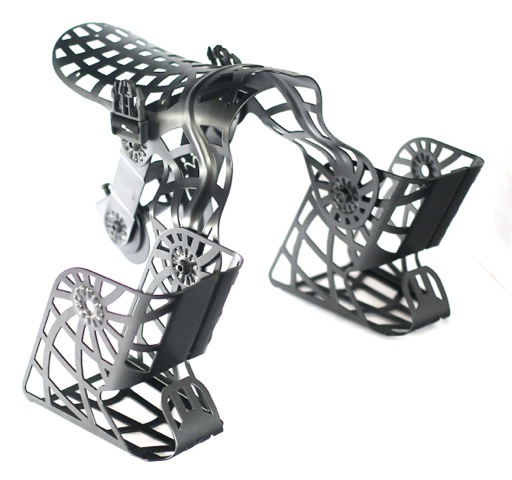 Child seats on the top tube
can also create ergonomics and clearance problems for the riders head/body and/or knees.
If the child seat interferes with the adult's pedaling motion they are arduous
for long rides and may lead to knee injuries. Depending upon the frame
angles, rise in the handlebars and the length of the bicyclist arms, the
bicyclist may have a problem comfortably reaching around the child. The front-mounted child seat product we know of are listed in
the chart below. A couple product we have seen are:
Child seats on the top tube
can also create ergonomics and clearance problems for the riders head/body and/or knees.
If the child seat interferes with the adult's pedaling motion they are arduous
for long rides and may lead to knee injuries. Depending upon the frame
angles, rise in the handlebars and the length of the bicyclist arms, the
bicyclist may have a problem comfortably reaching around the child. The front-mounted child seat product we know of are listed in
the chart below. A couple product we have seen are:
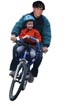 The Safe-T-Seat is a contoured
plastic seat (max. 32 lbs - 14 kg) that is mounted above the top tube on a
stinger attached to the handlebar stem, so it provides more knee clearance.
It initially installs in about a minute and can then be detached and reattached
in seconds, if you don't always need it on the bike. The more highly
engineered Co-Rider (max 44 lbs - 20 kg) is more like a thickly padded "English
saddle" and has a very narrow profile, so it offers even more knee clearance.
It takes longer to install, but then only a couple minutes to detach and
reattach.
The Safe-T-Seat is a contoured
plastic seat (max. 32 lbs - 14 kg) that is mounted above the top tube on a
stinger attached to the handlebar stem, so it provides more knee clearance.
It initially installs in about a minute and can then be detached and reattached
in seconds, if you don't always need it on the bike. The more highly
engineered Co-Rider (max 44 lbs - 20 kg) is more like a thickly padded "English
saddle" and has a very narrow profile, so it offers even more knee clearance.
It takes longer to install, but then only a couple minutes to detach and
reattach.
Child bike trailers
Trailers are more stable and affect the handling of the bike much less that bike seats. Trailers with chain stay (rear triangle) hitches affect bike handling less and are probably less likely to tip, than trailers with seat post hitches. Trailers also have the advantage of being able to carry larger children (1-4 years) and multiple children. (several trailers are rated to 45 kgs. or 100 lbs.) Kids can be set-in the trailer with toys, books, drink, food and other amusements. The fact that the child is surrounded by so much entertainment and can nap in comfort in their royal coach, the child can accommodate longer trips. Trailers can provide more weather protection against rain and sun . Sitting low, with a low center of gravity, falls are rare and short. The typical brightly colored fabric used on trailers is very visible to motorists. The down side is that the child sit low and has a restricted view. And, trailers have a larger foot-print, which may be a problem on narrow roads and in congested urban areas -- instead of sharing a lane, you are more likely to have to take-up a lane for safety. But, rather than inciting harassment, trailers more often seem to generate friendly curiosity. The best trailers have the added safety features of a five-point harness and roll-bar. Face forward designs allow easier communication between the cyclist and the child, than rear facing designs. The child is also easier to monitored with the use of a handlebar bar-end mounted rear view mirror.
Tip: If you have a bike trailer with a chain stay attachment and are carrying two kids, be sure to put the heavier kid on the side where the hitch extends out. If you hit a bump or curb just right the trailer can tip towards the hitch-side. The seatbelt/harnesses are good, as is the roll cage, but if the heavier kid landing on the lighter kid, it may be bad. If the smaller kid lands on the larger kid, well, they usually just giggle a lot. It is also recommend that the trailers occupants wear helmets.
Putting an infant in a infant car seat and then putting the car seat in a trail is not equivalent to using the same car seat in a car. The issue for infants is being jostled. Cars have sophisticated suspension system so that, on a paved road, passengers feel very little motion. Lacking any suspension system, the ride in a trailer, even on a paved surface, can have a variety movements, some can be quiet sharp. [If you would like to do an experiment; put a fish bowl full of water in a bike trailer and ride around with it. Watch the water.]
We don't know of any independent testing that has been done on child trailers, so we can't say which is best or safest. Things to look for are:
- Is the child prevented from interacting with the wheels in any way while in motion?
- Is the trailer stable, with a low center of gravity?
- Is the child protected from sand and grit thrown up by the bike tires?
- Is the hitch to the bike well designed and sturdy?
- Is the point where the hitching bar is joined to the trailer (a stress point) sufficiently strong?
- Is the harness for the child well designed and secure?
Other nice features:
- Can the bicyclist communicate with the child easily?
- Is there sufficient storage space to carry the child's supplies and other items (i.e. a bag of groceries)?
In some areas of Europe and Asia, cargo tricycles are used for transporting children.
Resource:
Rough Risk Analysis Child Seats vs Trailers
 Child seats create a higher center of gravity than trailers so in terms of
physics and stability they have a high risk. But we haven't heard of enough
accidents involving either to say that any higher risk is statistically
significant. The smaller the child, and more proficient and safety conscience
the cyclist, the more the risk for a child seat is reduced to about the same
level as for a trailer. Road and traffic conditions can also affect risk. Some
road and traffic conditions favor trailers and other conditions favor child
seats. Road and traffic considerations may be a more significant factor
than stability issues so it can't be said that one method is better than another
in a given situation.
Child seats create a higher center of gravity than trailers so in terms of
physics and stability they have a high risk. But we haven't heard of enough
accidents involving either to say that any higher risk is statistically
significant. The smaller the child, and more proficient and safety conscience
the cyclist, the more the risk for a child seat is reduced to about the same
level as for a trailer. Road and traffic conditions can also affect risk. Some
road and traffic conditions favor trailers and other conditions favor child
seats. Road and traffic considerations may be a more significant factor
than stability issues so it can't be said that one method is better than another
in a given situation.
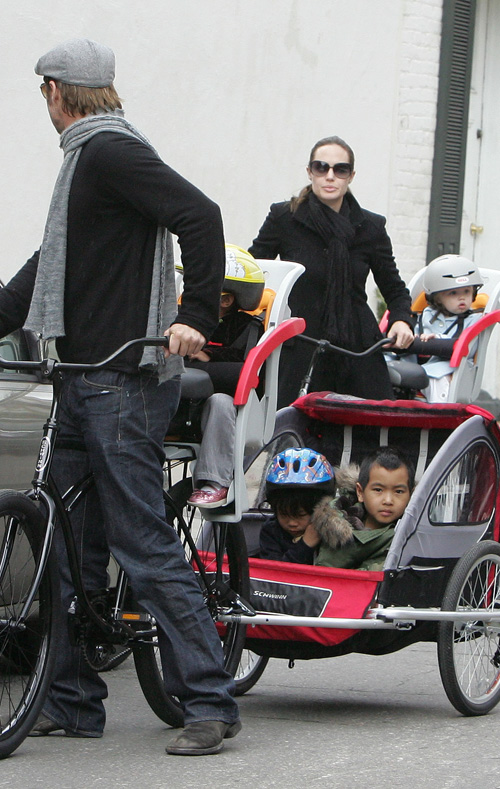
Angelina Jolie with Brad Pitt,
Bicycling in New Orleans - Dec 22, 200.
Photo Credit: SpashNewsOnline.com
Resource:
How to Choose A Child Bike Seat
Some manufactures of child seats:
| CoPilot Limo | Co-Rider (front mounted) | |
| Kettler | Kool Stop Bobike |
iBert Safe-T-Seat (front mounted) |
| Topeak | TykeToter (front seat) | WeeRide |
Post Child Seats and Trailers -- Third Wheel Cycles
If you want to have a family outing with a distant destination, as you child outgrows their child seat (~ age 3) or trailer (~ age 4), there are a couple of options to consider: tandems (and even triples and quads) with child stoker kits (a.k.a kidback, kid-back or kid kit) on the rear seat(s) and third wheel / trailer cycles. In both cases your children will be right with you no matter how fast you ride. People have done some serious bike touring on both kinds of set.
On a conventional tandem both cyclists have to pedal together, so when the adult pedals the child will have to pedal, unless they take their feet off the pedals. DaVinci Design has engineered an "Independent Coasting System" which frees the riders from having to pedal in unisons and has other benefits.
The third-wheel cycles are designed to be free wheeling so the child can just sit back and enjoy the ride whenever they want. Generally, it is easier to fit a child to a third wheel cycle (about age 3) than to an adult tandem stoker (rear) seat (about age 4 or 5). And if you don't already have a tandem it is a much bigger investment.
Resource:
Infant, Toddler and Child Helmets
Does an infant need to wear a helmet when he or she is traveling by bike?
Regardless of where the infant is transported, we favor the use of a bike helmet designed for infants whenever they are traveling by bike -- in some areas it is the law. Because of the fontanel -- soft spot in an infants skull -- infants are susceptible to more head injuries than adults. Regardless of regulations, in a child seat it is strongly advisable children wear a helmet. Hopefully, you won't be involved in an accident, but should you be, a helmet can reduce injuries.
The use of a helmet in a well designed trailer with a good harness/restraint system it is more debatable. One argument for using a helmet is it starts a good habit (but then there are those who argue that wearing a helmet is not a good habit.) Most trailers have good enough harnesses (if properly used) and cages that if the trailer should roll over the child's head is never going to come in contact with anything hard, so a helmet is superfluous. In such an accident, any injury is going to come for jostling the head and neck. In which case, theoretically the weight of the helmet might exacerbate the injuries (but a good infant helmet weighs only a few hundred grams). "Aero" shape helmets are not good for children in child seats or trailers since the tail hits the back of the seat and forces the child's head sharply forward out of a natural position, can push the helmet forward over their eyes and can add tension to the chin strap choking the baby.
The counterpoint is: If the baby's neck is not strong enough to handle some jostling, he or she shouldn't be in the trailer (or child seat) yet. Check with the baby's physician about when is the right time to start taking the baby by bike.
Children often fall asleep in trailers. If a child dozes in a seat or trailer their head may loll and bounce around, a situation pediatricians say is not good. The helmet can help to cradle and protect their head as the lean over. Additional it may be helpful to provide side cushions or some other means to can support the head, or be prepared to stop whenever the child gets sleepy.
When selecting a helmet, it is more important that the helmet meets a recognized standard (i.e. ASTM) and fits properly, than who makes the helmet. The helmet should sit so that it covers the forehead, not worn like a yarmulke or skullcap. For helmets worn in a trailer and child seats, the helmet should be rounded in back -- not flared. Helmets for infants and children are generally available from Seven Star Sports and Met. For more information on helmets go to www.ibike.org/education/helmet.htm.
Feedback clipped from our inbox
Submitted by (m***i@gmail.com) on Tuesday, April 29, 2014 at 15:21
MessageType: praiseMessage: Your information is of great use. Thank you for being thorough and accurate. You are helping keep children safe everywhere! And you have created a wonderful internet site, making great use of technology. Using the web to connect people and information at high levels and intelligence is the way to the future.
---------------------------------------------------------------------------
Submitted by () on Friday, June 15, 2007 at 11:26:16
MessageType: praiseMessage: I must commend you on providing such thorough and un-biased information on kids safety. I came across your site randomly looking for a kid seat for my wife's bike. Many of the topics you cover I had not even considered like trying to get off your bike when a kid is mounted in the front. I found your information extremely useful and spot-on for my shopping needs.
Thank you for taking the time to educate people on these issues. In this day and age you can not trust feedback on amazon.com-like sites where people will give high ratings because they have a formal association to the product. I can now go and buy a baby seat in confidence!
---------------------------------------------------------------------------
Submitted by Benjamin C (***@yahoo.com) on Friday, September 14, 2007 at 14:12:52
MessageType: praiseSubject: Baby Bike Safety Info
Message: Thank you for your wonderful info. I came across this site randomly after a google search, and found your summary of trailer-vs-bikeseat discussion exactly what my wife and I were looking for. It was both complete and well-presented. Keep up the good work!
- Ben---------------------------------------------------------------------------
Submitted by () [from Australia] on Friday, October 5, 2007 at 21:43:50
MessageType: praiseSubject: child carrier
Message: Thanks for the great info, I had been looking at my options and hadn't considered some of the safety and practical points made in this article. Great work keeping kids safe with good advice, thank you!---------------------------------------------------------------------------
Submitted by Jill B (***@hotmail.com) [from Scotland] on Sunday, October 21, 2007 at 13:52:58
MessageType: praiseSubject: Teaching kids to cycle
Message: My 4 1/2 year old was pedalling on his own after just 15 mins of using your advice - thank you! Saved my back a lot of pain!---------------------------------------------------------------------------
Submitted by () from USA on Thursday, September 25, 2008 at 14:23
MessageType: praiseSubject: well done and unbiased
Message: Lots of little tidbits to inform the consumer. I particularly liked the comment about a flared back on a helmet in a bike trailer not permitting a child to rest his/her head comfortably. I am still mulling over front vs rear seat for toddler, but now I feel I will have a more sophisticated thought process.
We welcome additional information, anecdotes or feedback regarding any of this material.
Bicycle Safety Education Literature, Bike Helmet Offers and Safety Materials
Teach Your Children Well: A primer on helping your kids to have more fun cycling.
IBF's Bicycle / Safety / Sustainability Bibliography / Reading List
Home | About Us | Contact Us | Economics | Education | Encouragement | Engineering | Environment | Bibliography | Library

The International Bicycle Fund is an independent, unincorporated entity. Its primary purpose is to promote bicycle transportation. Most IBF projects and activities fall into one of four categories: planning and engineering, safety education, economic development assistance and promoting international understanding. IBF's objective is to create a sustainable, people-friendly environment by creating opportunities of the highest practicable quality for bicycle transportation.
 Please write if you have questions, comment, criticism, praise or
additional information for us, to report bad links, or if you would like to be
added to IBF's mailing list. (Also let us know how you found this site.)
Please write if you have questions, comment, criticism, praise or
additional information for us, to report bad links, or if you would like to be
added to IBF's mailing list. (Also let us know how you found this site.)
"Hosted by
DreamHost - earth friendly web hosting"
Created by David Mozer.
Copyright ? 1995-2026 International Bicycle Fund. All rights reserved.